
RSS has a business problem, not a technical one
I believe RSS syndication has a fundamental problem that limits its adoption. It's not anything technical — not the format, not the readers. It's the content: it is very hard to make a living by publishing full content via RSS.
How the web pays for content today
Most professional journalism today either sits behind a paywall or is plastered with ads, popups, and whatever else is needed to squeeze a penny or two out of a non-paying visitor. Both approaches are annoying. Beyond the financial aspect, nobody enjoys managing subscriptions to a dozen paywalled websites. And there is probably no person in the world who isn't annoyed by aggressive online ads.
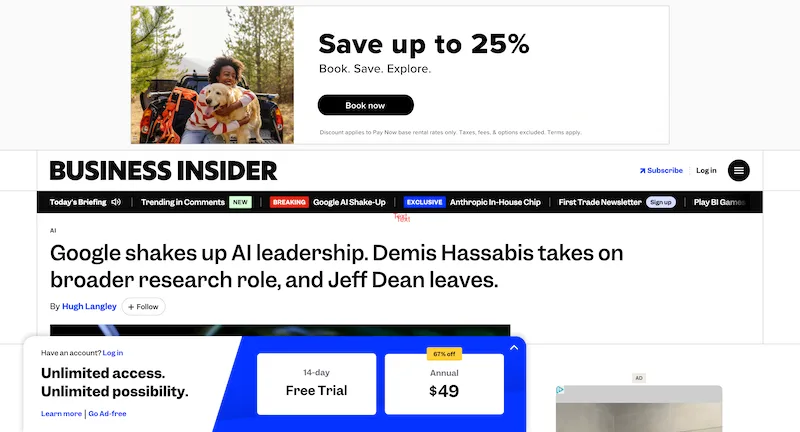
After 30 years of news on the internet, there is still no common solution that pays the authors of a website without being a hassle for the reader.
This situation is unique to short-form reading. Music is easy to obtain, as long as you pay a monthly fee to Spotify or one of its many competitors. Musicians may complain that the income is thin, but it's enough to sustain a steady flow of new content from practically every artist. Short videos are distributed on YouTube, Facebook, and TikTok, and creators get paid - either viewers watch ads, or they subscribe to something like YouTube Premium.
What makes music and video easier to monetize than websites is, of course, the gatekeeper. YouTube only lets you watch a video if you either pay for Premium or sit through YouTube's ads. There is no equivalent gatekeeper for websites. In many ways it's a good thing that Chrome doesn't show us an ad before we can follow a link. But it also means that only the site itself can generate revenue, and in practice it does so in the most annoying ways imaginable.
Where that leaves RSS
RSS is already an awesome way to read content the reader doesn't pay for. In an ideal world, you could read your newspaper, the NYT or whatever you prefer, in the RSS reader of your choice instead of going to their website or app. Unfortunately, that's not possible. Not for technical reasons, but because there is no viable business model for it today.
That doesn't mean RSS is useless. It's great for personal blogs - if that's all you want to read, you can find more blogs than you could ever read. It also works well for product and company blogs like the Google Blog, where the article isn't the product but a way to sell you the actual product. Podcast feeds are similar: the feed is free and delivers an audio file that may contain ads and sponsorships that are hard to skip.
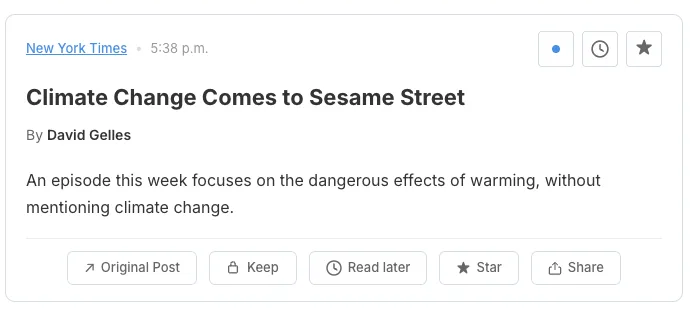
Only journalism and similar content - where the article is the product - has no solid way of making revenue from an RSS feed. The most common workaround is truncated content, often just a headline and a single sentence. Enough to decide whether you want to read the article, but to actually read it, you have to leave your RSS reader and open the site's app or website:
Some sites offer paid, ad-free subscriptions that include a full RSS feed. This is a wonderful way to read your news, but it's mostly limited to a handful of tech sites. The Verge and Ars Technica are two of them. It can be a good solution for the sites you read most, but it's inconvenient: a "secret" URL that has to be copied into your reader, and one more subscription to manage, per site.
What RSS actually needs
What RSS needs is a way for authors to get paid while readers enjoy the full article inside their feed. Ideally something like the YouTube model: read articles with ads for free, or pay for an ad-free subscription. Publishers would get either a fixed amount per article delivered, or a share of a subscriber's fee proportional to how many of that subscriber's articles they provided.
The big question is how to get there, given how fragmented the RSS reader market is.
The Spotify model - every reader negotiating paid full feeds - is unrealistic for a million reasons: tiny teams, solo devs, non-commercial projects, or simply no interest. The YouTube model - a single dominant player offering it exclusively - doesn't work either, because no single reader has enough users to get publishers interested. And ad-supported feeds can't work in open-source readers, since the ads are trivially stripped out - though open-source users could still use paid full feeds.
A reselling portal
I think the logical model is a reselling portal. It negotiates contracts with publishers and obtains full feeds. Readers of any app, however small or independent, subscribe directly to the portal and get access to the full feeds via secret, per-user URLs, conveniently importable via OPML. And RSS readers that integrate with the portal directly could offer both seamless access to the paid feeds and ad-supported free viewing.
One subscription, every reader, full articles. That's the missing piece.